Observability
OpenAPPA exports traces, logs, and metrics through OpenTelemetry (OTEL). You can send this telemetry to an OTEL-compatible collector or provider.
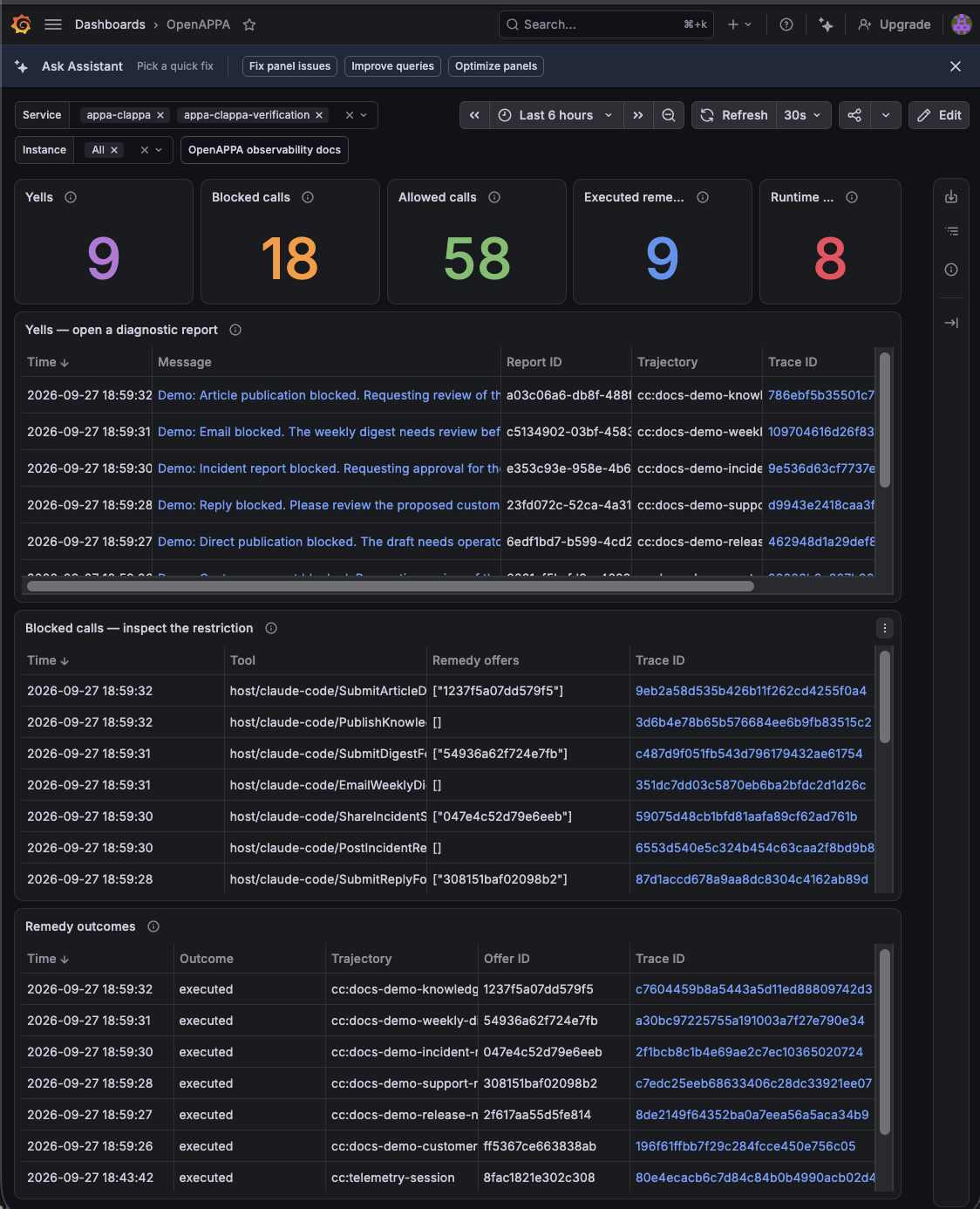
The export covers tool proposal checks, external calls, store failures, remedies, hooks, and agent reports. Policy-check time includes external and storage time. It excludes agent model inference and tool execution. An Annotator's model call counts as external-call time.
The runtime exports operational events with the appa_telemetry target. Optional diagnostic snapshots use the log-only appa_yell_snapshot target. The -v and -vv options change stderr detail independently. The exporter does not capture function arguments.
OpenTelemetry export#
Configuration#
Set the collector base URL on the process that runs APPA. Then restart that process.
export OTEL_EXPORTER_OTLP_ENDPOINT="http://localhost:4318"
export OTEL_SERVICE_NAME="appa-runtime"
export OTEL_RESOURCE_ATTRIBUTES=\
"deployment.environment.name=staging"
| Variable | Purpose |
|---|---|
OTEL_EXPORTER_OTLP_ENDPOINT | Required collector base URL. If unset or empty, APPA does not start the exporter. |
OTEL_SERVICE_NAME | Service name shown in your backend. The default is appa-runtime. |
OTEL_RESOURCE_ATTRIBUTES | Comma-separated resource attributes, such as the deployment environment. |
OTEL_EXPORTER_OTLP_HEADERS | Optional collector authentication headers. Supply them through your secret manager. |
OTEL_SDK_DISABLED | Set to true to disable export, even when an endpoint is set. |
APPA_OTEL_YELL_SNAPSHOT | Set to true to also export filtered agent yell reports as logs. Disabled by default. |
APPA exports OTLP over HTTP with protobuf encoding. It uses /v1/traces, /v1/logs, and /v1/metrics under the base URL. Inside a container, localhost refers to that container.
Every record includes service.name. APPA also sets service.version to the runtime package version. The OTEL SDK adds configured resource attributes.
Enabling export is operator consent to send this bounded telemetry. Names, identifiers, and agent report messages can still contain sensitive information. Restrict access and retention in your collector and provider.
Collector setup#
Enable an OTLP HTTP receiver and trace, log, and metric pipelines. This local configuration prints received telemetry to the collector output:
receivers:
  otlp:
    protocols:
      http:
        endpoint: 127.0.0.1:4318

exporters:
  debug:
    verbosity: detailed

service:
  pipelines:
    traces:
      receivers: [otlp]
      exporters: [debug]
    logs:
      receivers: [otlp]
      exporters: [debug]
    metrics:
      receivers: [otlp]
      exporters: [debug]
This example accepts connections from the same host only. If APPA runs elsewhere, change the receiver address. Permit connections only from APPA.
To send data to a provider, replace debug in each pipeline with the provider exporter. Then configure its credentials.
Run an agent tool proposal. Search the provider for appa.policy.decision under the configured service name.
Metrics#
The table shows Prometheus mappings. OTLP uses the dotted names without Prometheus counter and unit suffixes.
| Prometheus mapping | OTLP name | Type | Labels |
|---|---|---|---|
appa_policy_decisions_total | appa.policy.decisions | Counter | outcome |
appa_policy_check_duration_seconds | appa.policy.check.duration | Histogram, seconds | outcome |
appa_external_calls_total | appa.external.calls | Counter | role, outcome |
appa_external_call_duration_seconds | appa.external.call.duration | Histogram, seconds | role, outcome |
appa_remedy_attempts_total | appa.remedy.attempts | Counter | outcome |
appa_remedy_duration_seconds | appa.remedy.duration | Histogram, seconds | outcome |
appa_yell_reports_total | appa.yell.reports | Counter | source |
appa_runtime_failures_total | appa.runtime.failures | Counter | component, error_type |
appa_runtime_uptime_seconds | appa.runtime.uptime | Gauge, seconds | none |
The policy metrics measure tool proposal checks only. The decision counter uses allowed and denied. The duration histogram also uses error for failed checks. External outcomes are answered or no_answer. Remedy outcomes are executed, declined, no_answer, or refused. Agent reports use source="agent".
Remedy metrics cover attempts with a valid, released offer. Requests refused before APPA identifies that offer do not count as remedy attempts.
The metrics do not use tool names, external names, or identifiers as labels. This design bounds metric cardinality.
A runtime refusal is not a policy denial. The runtime records it as an error or a hook outcome. A store failure can also cause a policy failure. Thus, the sum of failure metrics does not identify a unique count of failed calls.
Example queries#
Denied tool proposal checks per second over the last five minutes:
sum(
  rate(appa_policy_decisions_total{outcome="denied"}[5m])
)
The 95th-percentile policy-check duration in seconds:
histogram_quantile(
  0.95,
  sum by (le) (
    rate(appa_policy_check_duration_seconds_bucket[5m])
  )
)
These queries require a Prometheus-compatible backend that receives the exported metrics.
Logs#
Filter structured logs with appa.event.name:
| Event | Exported event fields |
|---|---|
appa.policy.decision | appa.tool.name, appa.outcome, appa.offer.ids, appa.duration.seconds |
appa.external.completed | appa.trajectory.root, appa.external.name, appa.external.role, appa.outcome, appa.error.type, appa.duration.ms |
appa.remedy.completed | appa.trajectory.root, appa.offer.id, appa.outcome, appa.duration.ms |
appa.hook.completed | appa.trajectory.root, appa.hook.event, appa.outcome |
appa.runtime.failure | appa.component, appa.error.type, plus appa.trajectory.root and appa.operation for store failures |
appa.yell.report | appa.trajectory.root, appa.report.source, appa.report.id, appa.report.message |
Operational telemetry does not send raw prompts, tool arguments, tool results, provenance, audience sets, or trust claims. It also excludes policy feedback, review text, and remedy display text. Optional yell snapshots include the existing report's filtered policy, labels, and diagnostic facts, as described below.
APPA bounds caller-controlled exported identifiers and names to 256 UTF-8 bytes. A policy decision exports at most 32 offer IDs.
Traces and correlation#
OTEL logs correlate with spans through their native trace_id and span_id. The appa.policy.check span carries appa.trajectory.root, appa.trajectory.id, appa.tool.call.id, the tool name, and outcome. appa.policy.id identifies the trajectory's pinned policy when the check reaches policy evaluation. A host that supplies no call ID leaves that field empty.
A blocked check records appa.policy.gaps and appa.policy.narrowing on its span. Gap classes are trust_floor, includes, cap, prior, no_prior, and . These explain the restriction without exporting audience members or call values. A marked spawn can need a return declaration without a gap or narrowing.
Each served hook, remedy, and report starts its own trace. External calls create child spans within the operation that invokes them. APPA does not extract an incoming traceparent, and it does not create one trace for a full trajectory.
Correlate separate events with appa.trajectory.root or appa.offer.id. Use native trace correlation for events within one hook, remedy, or report operation.
The standalone appa runtime process owns this exporter. An embedding host owns its tracing subscriber and metric provider. The library emits instrumentation but does not configure an exporter from environment variables.
Export runs on background workers with bounded queues. A failed export cannot change a policy decision. Queue overflow, process termination, or collector failure can lose telemetry. With export enabled, SIGINT and SIGTERM flush completed records before exit. In-flight operations are not guaranteed to finish. Telemetry is not a durable audit log.
Agent reports#
An approved agent report exports appa.yell.report after APPA prepares the filtered report. The event contains the message, report ID, source, and root trajectory ID. APPA exports this event even if delivery to the report receiver later fails.
By default, the full filtered report goes only to the receiver configured by APPA_YELL_ENDPOINT. CLI report previews and CLI reports do not enter OTLP export.
Send diagnostic reports to Grafana#
With Grafana Cloud's OTLP endpoint and credentials configured, enable report export:
export APPA_OTEL_YELL_SNAPSHOT=true
Restart the runtime to send new approved agent reports to Loki as well as the report receiver. Other OTLP log providers work too.
This is a diagnostic report, not conversation replay. The existing filtering rules remove message bodies, argument values, and tool result bodies. The report retains the free-form yell message and filtered policy and trajectory diagnostics. It respects the call's with_trajectory choice and the report builder's size limits and omission markers.
This opt-in authorizes an additional destination for that filtered report. Filtering uses fixed report rules, not a destination-specific engine policy check. Restrict Grafana access and retention accordingly.
Each appa.yell.snapshot log carries up to 16 KiB of the report in appa.report.chunk. It also carries these fields:
| Field | Meaning |
|---|---|
appa.report.id | The same ID as the yell event and receiver report. |
appa.trajectory.root | The root trajectory identifier. |
appa.report.chunk.index | Zero-based position in the report. |
appa.report.chunk.count | Expected number of records for this report. |
appa.report.bytes | Total UTF-8 bytes in the finished report. |
Records carry the yell's native trace and span IDs. Snapshot content does not enter spans or stderr, including verbose stderr.
In Grafana Explore, select Loki and filter by report ID. Grafana maps dotted OTLP attribute names to underscores:
{service_name="appa-clappa"}
  | appa_event_name="appa.yell.snapshot"
  | appa_report_id="REPLACE_WITH_REPORT_ID"
  | line_format "{{.appa_report_chunk}}"
For reconstruction, sort records by numeric chunk index and concatenate their chunk fields without separators. Require every index from zero through count minus one. Check the total byte length before parsing the report as JSON. Missing chunks mean an incomplete export, not policy-withheld content. Export queues and provider limits can lose records. The diagnostic report itself can also contain omission markers from its existing size limits.
OpenTelemetry does not change report approval or delivery rules. It does not bypass the agent-reporting opt-in or add a confirmation bypass. See appa yell for report controls.
Improve policies from evidence#
Observability tools can flag repeated denials, slow external calls, or unsuccessful remedies. These patterns need investigation. They do not prove an attack or a policy defect.
An agent can review decisions and appa yell reports in a maintenance cycle. It can then propose a tested appa.toml change.
Compare denials, remedy outcomes, runtime failures, and policy-check time before and after a change. Tests of prohibited calls make sure the policy keeps the intended restrictions.